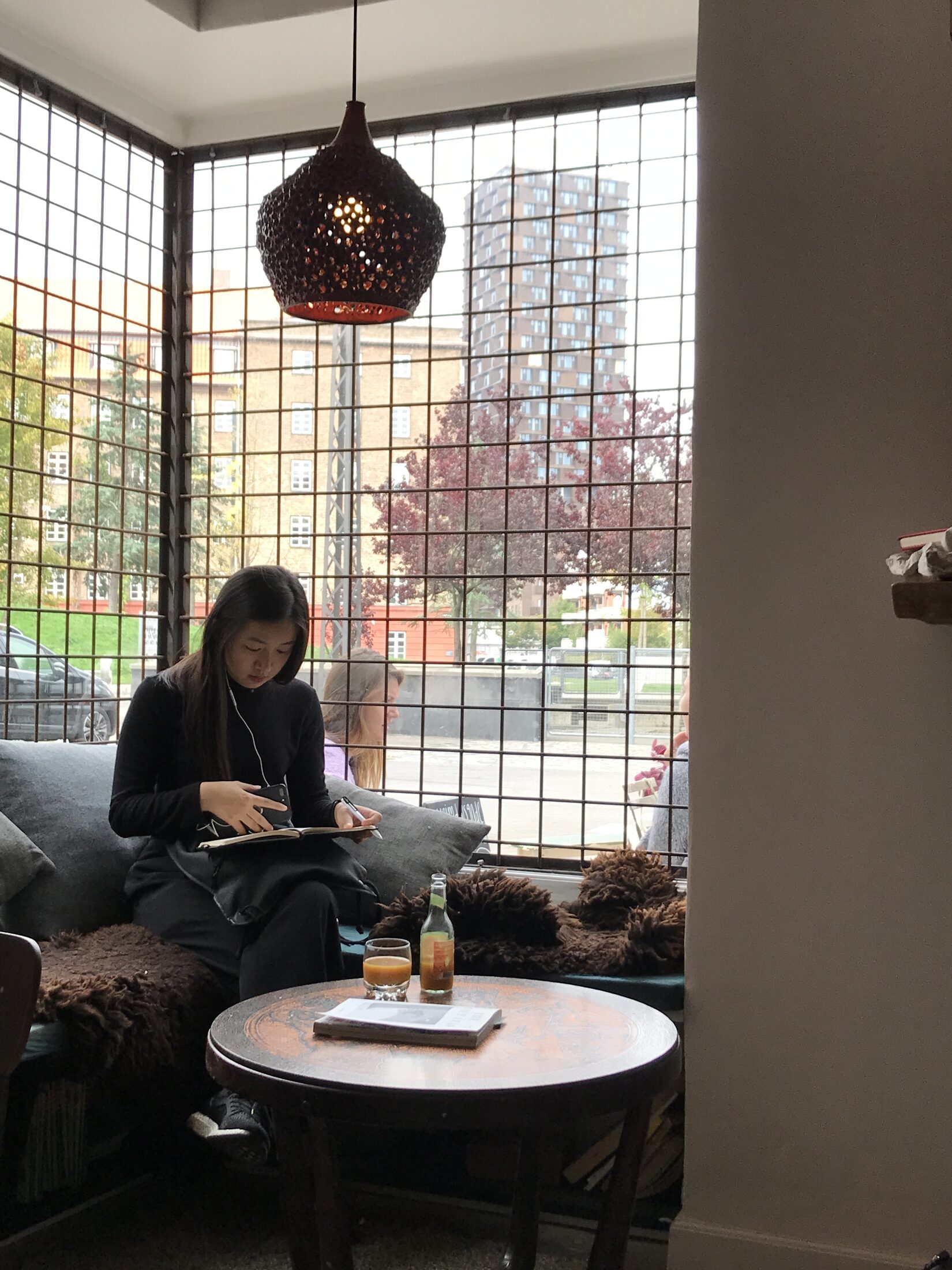
Hoi Yee Lim drawing in a café

About

Nothing here was a career plan. In hindsight it looks like one.

People don't remember beautiful spaces. They remember spaces that make sense.

Four moves

Still going

Where I learned to think about the whole.

Architecture was where I learned to look at a project before looking at its appearance.

The training taught me to ask what a project is for, how people will move through it, how it sits within its surroundings, and how structure, light, orientation and circulation shape the experience long before materials and finishes are chosen.

That way of thinking has stayed with me. Whether the project is 45,000 m² or 250 m², the scale changes, but the question does not: what is the idea, and is it strong enough to guide the decisions that follow?

Where I learned to care about the details.

Interior design brought me much closer to the things people actually touch, see and use.

A concept does not end when the space is drawn. It continues through the junction between two materials, the height of a counter, the proportion of a piece of furniture, the position of a light, or the way signage meets the architecture.

Working across interiors taught me that these details are not separate from the concept. They are where the concept becomes tangible.

It also changed the way I think about scale. At interior scale, design is experienced directly and continuously. People may never notice the reasoning behind a space, but they notice when something feels awkward, confusing or out of place.

Where I learned how design survives reality.

Designing a space and delivering one are two different skills.

Working on experience centres, retail, restaurants and other interior projects from concept through construction taught me to think beyond the drawing: how a material will actually be built, how a detail will be coordinated, what happens when a specification changes, and which decisions need to be protected when a project inevitably evolves.

This is where I learned that good design is not only about having a strong idea. It is also about knowing which parts of that idea matter most, and communicating them clearly enough for the whole team to carry them through.

Add here One short, specific story: a project where you protected a decision that would otherwise have been value-engineered away, and what would have been lost. Two or three sentences.

Where I started looking beyond the work itself.

Design is not a discipline that stays still. The tools change, the way people work changes, and the expectations around what a designer can do keep expanding.

Throughout my career, I have always been interested in learning what comes next. Not simply to keep up with new tools, but to understand whether they can change the way I work for the better.

That has led me from learning new software and workflows to thinking more systematically about how information is organised, how decisions are made, and how different parts of a project connect. Experience gives you patterns; systems give those patterns structure.

AI has opened another layer of that exploration.

While much of the current conversation focuses on what AI can generate, I am more interested in the possibilities around it: how it can help designers understand complexity, structure information, explore possibilities, make better decisions and reduce the friction between different stages of a project.

The goal is not to replace the designer, or to automate everything that can be automated. It is to question the way we work now, find where technology can genuinely add value, and create more space for judgement, curiosity and creativity.

For me, learning does not stop when I become good at something. The next question is always: what else could be possible?

How I work

Three capabilities

Employers are a poor description of a skillset. This is closer.

Design strategy

Reading a brand, or a household, until its own logic shows itself, then turning that logic into a spatial argument the whole team can work from.

  • Brand reading
  • Concept development
  • Spatial narrative
  • User journey & behaviour

Spatial design

Taking that argument through plan, section, material and detail without losing it, and without making a room people have to work around.

  • Retail & F&B
  • Workplace & office
  • Experience centres
  • Residential
  • Signage & wayfinding

Project leadership

Holding intent intact across borders, consultants and construction, from tender documentation through to handover.

  • Cross-border coordination
  • Consultant & LDI management
  • Tender documentation
  • Site supervision & delivery
  • EN · 中文 · 粤语 · BM

Practice history

2014 →

Founder / Creative Lead

H.Society (Shanghai) Co., Ltd
珩优建筑设计(上海)有限公司
2022 — present

Founded and led an independent design practice working across interior design, branding, and emerging AI-driven design workflows. The studio provided an opportunity to explore a broad range of project types and scales, including residential interiors, restaurants, retail and commercial spaces, signage, branding, and experimental digital and AI applications.

Projects and collaborations extended across Shanghai and other cities in China, as well as Malaysia and Macau. Worked with overseas design partners and studios in Hong Kong and Amsterdam, as well as Shanghai-based teams with international backgrounds. Depending on the project, involvement ranged from design development and spatial concepts to visual direction, client communication, coordination, and project management across different stages of delivery.

Working across these different contexts developed an understanding of how international design thinking and expectations can be translated into local project realities, while also building practical experience in managing the requirements of delivering projects within the Chinese market.

Beyond client work, the practice became a space to experiment, explore, and work beyond the conventional boundaries of interior design. It allowed me to move between different design disciplines, test new ways of thinking, and explore emerging tools and technologies, including AI, as part of an ongoing curiosity about what design can become.

Senior Architect

GALA CHINA
盖蓝建筑设计(上海)有限公司
2020 — 2023

A role centred on bridging international design intent with the realities of delivering projects in China.

Working across large-scale developments in Lingang with Studio Daniel Libeskind, MMA, SBGA and Studio Marco Piva meant coordinating between international design teams, local design institutes, façade consultants and authorities.

It taught me that on complex projects, design is often less about producing another drawing and more about keeping the original idea clear as it moves between different teams, disciplines and requirements.

Architectural Designer

SPACEMEN STUDIO
上海里优装饰设计有限公司
2018 — 2020

A deliberate move into an unfamiliar environment and a different way of working. I had to start from the basics again, this time in Shanghai and in a market that operated very differently from Malaysia.

Within two years, I was running experience centres, retail and restaurants from concept through handover. Working with clients including Haier and Vasen taught me to understand the business behind a brief before designing for it. The strongest spatial ideas often come from understanding what the business is already trying to say.

Assistant Architect

DMP Architects
2016

A short but formative period working on architecture design proposals and submission drawings across different scales, before leaving Malaysia to continue my architectural studies in London.

It was a transition between learning the fundamentals of practice and developing a more deliberate design approach through further study.

Assistant Architect

Arkitek Ari Methi
2014 — 2016

The start that mattered most. In a small practice, there was no single slice of a project to own. I was involved from the first client conversation through concept development, drawings and eventually the site.

Working across everything from furniture to mixed-use development gave me an unusually broad view of how a project comes together, and taught me early that design does not stop when the drawings are finished. Delivery was part of the work from the beginning.

Education

2010 — 2018

Two countries, and the point where design stopped being local.

MArch Architecture

University of East London, UK
RIBA / ARB Part 2 · First Class Honours
2016 — 2018

Thesis explored social infrastructure for Deliveroo riders in Bromley-by-Bow, with a glulam structure derived from bicycle geometry. The project combined social research, structural experimentation, and spatial design around the everyday realities of a specific community.

Alongside the thesis, completed a two-week full-scale build with Studio Bark, leading the design and fabrication of a demountable timber cladding system from jig-making through to assembly. Working at full scale offered a direct understanding of material behaviour, tolerances, fabrication, and the relationship between design intent and physical construction.

Studying and building in London alongside people from different cultural and professional backgrounds also challenged assumptions about what constitutes a universal design response. Designing within a context different from Malaysia became an important part of developing a more adaptable and outward-looking approach to design.

BSc (Hons) Architecture

Taylor's University, Malaysia
RIBA / ARB Part 1
2010 — 2013

Final year project explored the adaptive reuse of Sungai Lembing, a former tin-mining town in decline, using ecotourism as a means of directing economic activity back into the local community.

The project shifted my understanding of architecture from designing a building to responding to the larger social, economic, and cultural conditions around it. It was an early introduction to thinking about design as a tool for addressing problems beyond the physical space itself.

See the academic projects  ↗

Contact

Tell me what the project is supposed to say, and how people need to use it.

Open to new projects, collaborations, and conversations about how brand logic becomes built space.

Emailhoiyeelim@gmail.com LinkedInin/hoiyeelim
WeChathoiyeelim
Based inShanghai, China